
The DuPont Tyvek Users Manual introduces the advantages of DuPont Tyvek, including outstanding chemical resistance, good dimensional stability, compliance with FDA requirements, unique flammability, remarkable flexibility, low lint, light weight and strength, superior moisture resistance, withstand deformation, high opacity, whiteness, porosity, rot and mildew resistance, soiling resistance, neutral pH, static considerations, temperature impact, UV resistance, solvent resistance, solvent compatibility testing, toxicity MSDS, etc.
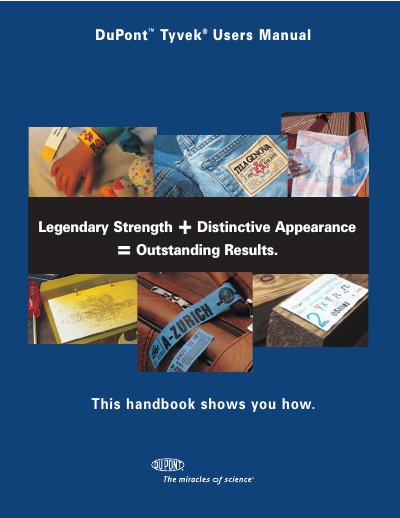
DuPont Tyvek® is a spunbonded olefin material made from polyethylene fibers, combining the best properties of paper, film, and fabric. It offers outstanding chemical resistance, dimensional stability, FDA compliance, and low-linting properties. The material is ideal for tags, labels, packaging, and cleanroom applications due to its durability, flexibility, and resistance to moisture and solvents.
Tyvek® comes in 'hard' and 'soft' structure types, each suited for different applications. Hard structures are smooth and stiff, while soft structures are flexible and embossed. Both types are printable and offer excellent bar code readability. The material is available in various basis weights and can be processed through multiple printing methods including offset, flexographic, and ink-jet printing.
| Chemical Resistance | Inert to most acids, bases, and salts |
|---|---|
| Dimensional Stability | Sheet dimensions change less than 0.01% between 0 and 100% relative humidity at constant temperature |
| FDA Compliance | Tyvek® 1059B meets 21 CFR 177.1520 for direct food contact applications |
| Flexibility | Exceeds 20,000 folding cycles without pre-scoring |
| Opacity | One of the highest opacity ratings in the printing industry |
| Whiteness | TAPPI Standard Test Method rating of 94.1 |
| Porosity | Low air permeability compared to textile fabrics, higher moisture-vapor transmission than plastic films |
DuPont™ Tyvek® is made from high-density polyethylene fibers bonded by heat and pressure, forming a spunbonded olefin material.
Tyvek® comes in 'hard' and 'soft' structure types. Hard structures are smooth and stiff, while soft structures are flexible and embossed.
Tyvek® 1059B meets FDA requirements for direct food contact applications under 21 CFR 177.1520.