
A comprehensive design guide for DuPont Delrin acetal resin covering properties, processing, compositions, and applications.
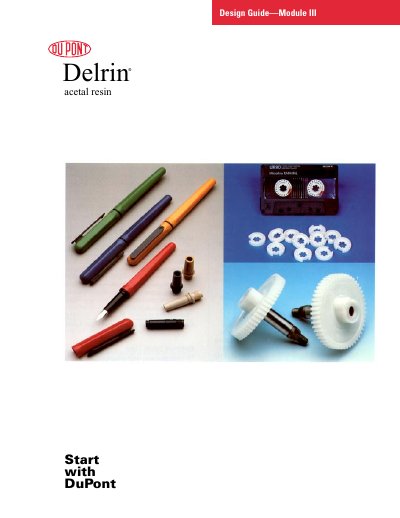
This document serves as a design guide for Delrin acetal resin, a highly versatile engineering plastic introduced by DuPont in 1960. It details the material's metal-like properties, including high tensile strength, impact resistance, and stiffness, bridging the gap between metals and ordinary plastics. The guide covers various industries such as automotive, appliance, construction, hardware, electronic, and consumer goods.
| Introduction Year | 1960 |
|---|---|
| Pellet Diameter | 2.5 mm (0.1 in) |
| Pellet Length | 2.3 mm (0.09 in) |
| Bulk Packaging Weight | 1,000 kg (2,200lb) |
| Bag Packaging Weight | 25 kg (55.1 lb) |
The main limitations are repeated use in steam or hot water, and exposure to strong acids or bases outside the pH range of 4–9.
The most commonly used method for processing Delrin is injection molding, though extrusion, stamping, and machining are also used.
Standard Delrin and Delrin P are available in several basic melt flow rates, including grades 100, 500, 900, and 1700.