
The document is an introduction to Barksdale's valve and regulator products.
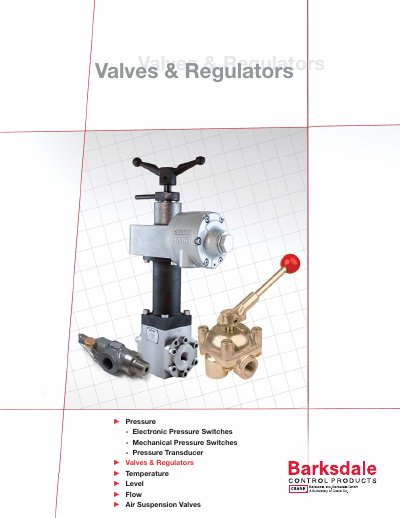
This supplemental guide covers Barksdale directional control valve and regulator products, including Shear-Seal valves, OEM valves, heavy duty valves, solenoid valves, hydraulic regulators, and a pressure relief valve. It includes interflow explanation, pressure drop and velocity curves, troubleshooting pointers, maintenance, and installation and operating instructions.
Specifications and options such as seal materials and modifications are listed for the valve series.
| Working pressure | Pneumatic or hydraulic from 150 psi to 350 psi (10.3 to 24.1 bar); see table |
|---|---|
| Back pressure | Must not exceed 250 psi (17.2 bar) at return port |
| Proof pressure | 1-1/2 times working pressure except at return port |
| Burst pressure | 2-1/2 times working pressure except at return port (300 psi, 20.7 bar) |
| Media temperature range | -40° to +250°F (-40° to +121°C) |
| Handle rotation | 90°; 45° each side of center |
| Detent | 3-position detent (except -MC, -MR options) |
| Wetted body material | Anodized aluminum |
| Standard O-ring material | Buna N |
| Pressure seal material | Brass |
| Rotor material | Hard anodized aluminum |
It is a small amount of fluid flow from the Pressure A and B ports to the return port through the clearance between the rotor and the body. It occurs when the valve is shifted or used for throttling, is not leakage, and does not occur when the valve is fully engaged.
A non-interflow valve may be required when precise control of a cylinder is needed and the small settling associated with interflow valves cannot be tolerated.
The recommended velocity is about 30 ft/sec (9.1 m/sec) for continuous operation, and the valve can handle up to 60 ft/sec (19.3 m/sec) for intermittent duty.
The solenoid should be cleaned at least every 1,000,000 cycles or every six months, and the valve should be checked every 2,000,000 cycles or once a year.