
A supplemental guide for Barksdale Shear-Seal directional control valves covering interflow characteristics, maintenance, pressure drop, velocity curves…
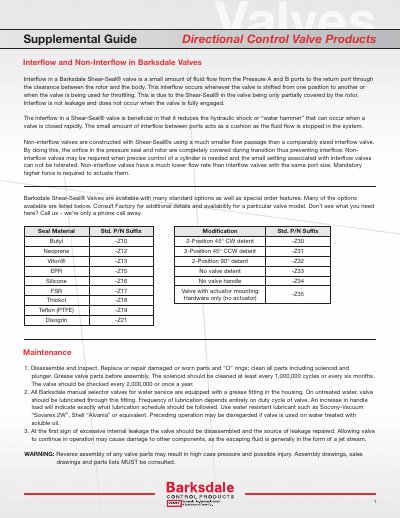
This document serves as a supplemental guide for Barksdale Shear-Seal® directional control valve products. It explains the concept of interflow, which occurs when the valve is shifted or used for throttling, and notes that this feature reduces hydraulic shock. The guide distinguishes between interflow and non-interflow valves, detailing the benefits and specific use cases for each type.
| Recommended continuous operation velocity | 30 ft/sec (9.1 m/sec) |
|---|---|
| Maximum intermittent duty velocity | 60 ft/sec (19.3 m/sec) |
| Solenoid cleaning interval | 1,000,000 cycles or every six months |
| Valve inspection interval | 2,000,000 cycles or once a year |
Interflow is a small amount of fluid flow from the Pressure A and B ports to the return port through the clearance between the rotor and the body, which acts as a cushion to reduce hydraulic shock.
Manual selector valves for water service are equipped with a grease fitting, and lubrication frequency depends on the duty cycle, though an increase in handle load indicates the need for lubrication.
Possible causes include restriction in the return port, incorrect installation, bent detent disk, dirt under the trust washer, worn pins, worn thrust washers, excessive pressure, or worn Shear-Seal lips.