
The document is a PDA55 operating manual, which introduces the characteristics and features of PDA55, including product functions, specifications, and usage methods.
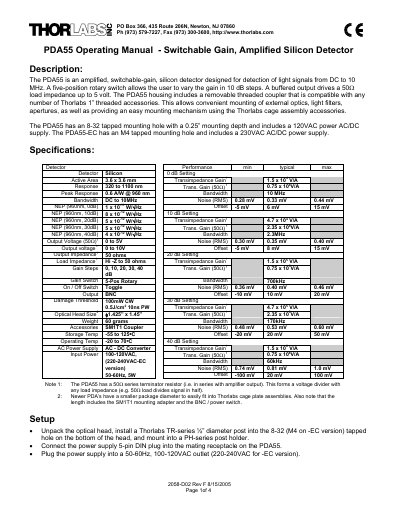
This manual provides instructions for setting up and operating the Thorlabs PDA55, an amplified, switchable-gain silicon detector for light signal detection from DC to 10 MHz. It includes details on mounting, power connection, gain adjustment via a rotary switch, and output specifications. The document also covers accessories, safety precautions, and maintenance guidelines, including cleaning procedures and WEEE disposal information for European users.
Performance specifications are listed for different gain settings, including transimpedance gain, bandwidth, noise, and NEP values. The manual advises users to avoid saturation by keeping output below 10V (5V for 50 Ω loads) and to use neutral density filters if necessary. It also warns against damaging the detector by ensuring fiber ferrules do not contact the diode during fiber adapter use.
| Active Area | 3.6 x 3.6 mm |
|---|---|
| Response Range | 320 to 1100 nm |
| Bandwidth | 10 MHz |
| Output Voltage (50 Ω Load) | 5V |
| Gain Steps | 0, 10, 20, 30, 40 dB |
| Operating Temperature | -20 to 70°C |
| Storage Temperature | -55 to 125°C |
Use a small slotted screwdriver to turn the internal gain-setting rotary switch. The gain is set to 0dB when the slot is aligned counterclockwise as far as it will go. Each clockwise click increases the gain by 10 dB.
The maximum output is 10 volts for high impedance loads (5V for 50 Ω loads). Adjust the gain to keep the measured signal below these levels to avoid saturation.
Clean the housing with a soft damp cloth. Clean the detector window only with optical grade wipes. Do not disassemble or contaminate the unit.