
The document describes the use of GenScript LIC Kit, including KIT components, vector description, PCR primer design, LIC cloning procedure, mammalian cell expression, bacteria expression protocol, baculovirus expression, moving genes to other vectors, cGFP as a positive control.
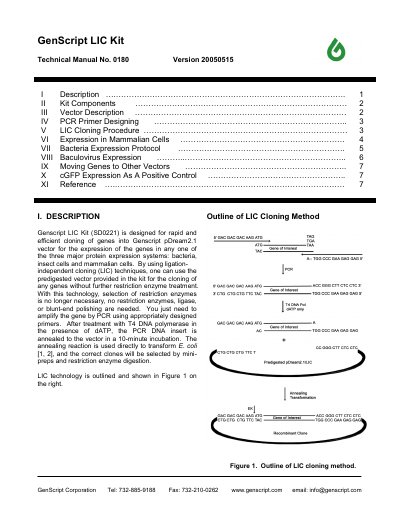
This manual details the use of GenScript’s LIC Kit (SD0221) for cloning genes into the pDream2.1/LIC vector without restriction enzymes. It covers PCR primer design, T4 DNA polymerase treatment, annealing, and transformation protocols for E. coli. It also includes protocols for expression in mammalian cells using Lipofectamine TM 2000.
The kit includes predigested vector, T4 DNA polymerase, buffers, primers, and a cGFP control insert. The manual provides step-by-step procedures for cloning, transformation, and expression, with notes on optimizing PCR, handling DNA, and transfection conditions.
It is designed for rapid and efficient cloning of genes into Genscript pDream2.1 vector for expression in bacteria, insect cells, and mammalian cells.
Forward primer: 5’- GAC GAC GAC AAG ATG ----, Reverse primer: 5’- GAG GAG AAG CCC GGT ----.
The recommended cell density is 90 -95%.