
RAE Systems PIDs can be used for the detection of a wide variety of gases that exhibit different responses.
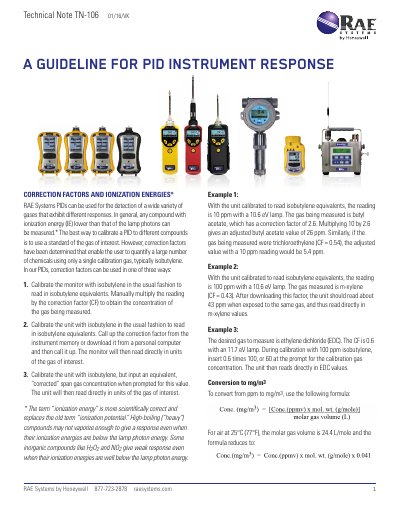
This technical note explains how to calibrate RAE Systems PIDs using correction factors and ionization energies to measure various gases. It covers methods for calibration with isobutylene, conversion to mg/m³, handling mixtures, and calibration characteristics including flow, pressure, temperature, matrix, concentration, filters, and instrument design. The document also includes a disclaimer about potential variations in correction factors and recommends calibrating to target gases for accuracy.
Use correction factors with isobutylene calibration. Multiply the reading by the correction factor or input the corrected span gas concentration during calibration.
Use the formula: For air at 25°C (77°F), the molar gas volume is 24.4 L/mole and the formula reduces to: A GUIDELINE FOR PID INSTRUMENT RESPONSE
Use the formula: CFmix = 1 / (Σ(Xi/CFi)), where Xi is the mole fraction of each component and CFi is its correction factor.