
This document introduces Schottky diode features and applications, including working principles, advantages and disadvantages, applicable scenarios, etc.
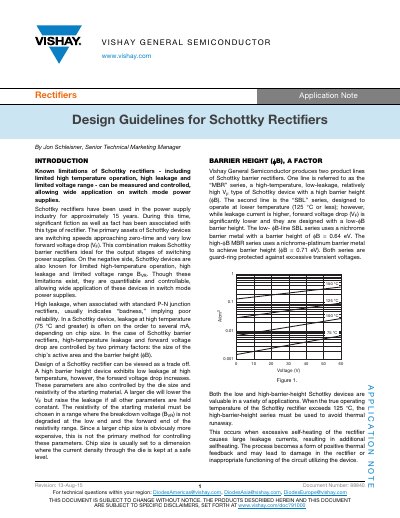
This document from Vishay General Semiconductor provides design guidelines for selecting Schottky rectifiers based on barrier height, temperature, and forward voltage drop. It explains how to calculate barrier height and use graphs to determine optimal device selection for efficiency. The document covers both MBR (high barrier) and SBL (low barrier) series, including their temperature limits and leakage characteristics. It includes equations and graphical methods for calculating current density and power dissipation under various operating conditions.
| Barrier Height (φB) - MBR Series | 0.71 eV |
|---|---|
| Barrier Height (φB) - SBL Series | 0.64 eV |
Use the equation: φB = (- KT/q) LN (J/R x T), where J is current density, T is temperature in Kelvin, K is Boltzmann’s constant, and R is Richardson’s constant.
It is the duty cycle point at which both a low- and high-barrier-height part dissipate the same amount of power, calculated using equations involving forward and reverse power dissipation.