
This manual provides information on how to use the testo 550s / 557s digital manifold. It covers safety and disposal, product approvals, product information, use, product description, first steps, using the product, Bluetooth, settings, Smart App and more.
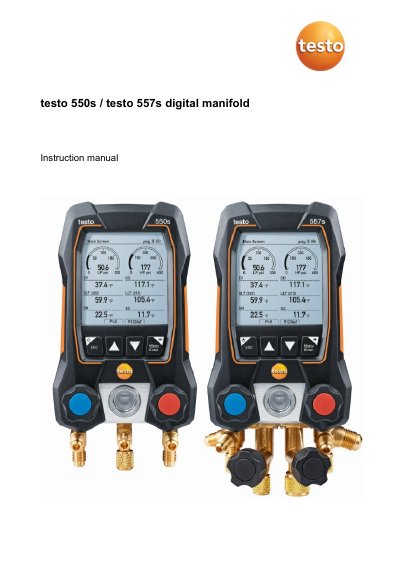
The testo 550s and testo 557s are digital manifolds designed for maintenance and service work on refrigeration systems, heat pumps, and air conditioning systems. These instruments replace mechanical manifolds, thermometers, and pressure/temperature charts, allowing users to apply, adapt, test, and monitor pressures and temperatures. They are compatible with most non-corrosive refrigerants, water, and glycol, but not with ammonia-containing refrigerants.
The manual details the operation of the instruments, including inserting batteries, switching the device on and off, and using the setup wizard. It covers various measurement modes such as Refrigeration, Evacuation, Pressure Leak Test, Target Superheat, Compressor Test (DLT), and Delta T. Additionally, it explains how to use the integrated Bluetooth connection with the testo Smart App and Smart Probes, as well as settings for duration, brightness, and units.
| Measurable media | all media that are stored in the testo 557 |
|---|---|
| Not measurable media | ammonia (R717) and other refrigerants which contain ammonia |
| Operating temperature | -20 to 50 °C / -4 to 122 °F |
| Storage temperature | -20 to +60 °C/-4 to 140 °F |
| Housing material | ABS/PA/TPE |
| Dimensions | approx. 235 x 121 x 80 mm |
| Weight | 930 g (without batteries) |
| IP class | 54 |
| Battery life (display off, Bluetooth off) | > 250 h |
| Battery life (display on, Bluetooth on) | > 100 h |
| Response time | 0.5 s |
| Pressure resolution | 0.01 bar/0.1 psi/1 kPa/0.001 Mpa |
| Temperature resolution | 0.1 °C / 0.1 °F / 0.1 K |
| Vacuum resolution (0 to 1000 microns) | 1 micron |
No, the instruments are not compatible with refrigerants containing ammonia.
Battery life is greater than 250 hours with the display and Bluetooth off, and greater than 100 hours with them on.
No, it is not possible to charge rechargeable batteries in the instrument.
The response time is 0.5 seconds.