
This document describes the features and characteristics of the ADP1974 bidirectional synchronous PWM controller, including input voltage range, on-board linear regulator, BUCK/CHARGE or BOOST/DISCHARGE mode, high PWM linearity, programmable dead time control, adjustable frequency, synchronization output or input, programmable maximum duty cycle, etc.
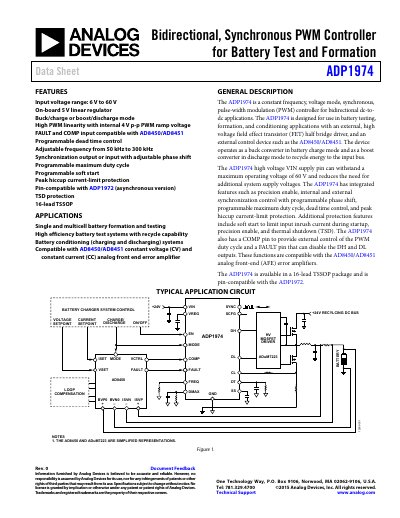
The ADP1974 is a constant frequency, voltage mode, synchronous pulse-width modulation (PWM) controller designed for bidirectional dc-to-dc applications. It is specifically intended for battery testing, formation, and conditioning, operating as a buck converter in charge mode and a boost converter in discharge mode to recycle energy. The device integrates features such as precision enable, internal and external synchronization control, programmable maximum duty cycle, and peak hiccup current-limit protection, and is compatible with the AD8450/AD8451 analog front-end error amplifiers.
The controller operates with an input voltage range of 6 V to 60 V and includes an on-board 5 V linear regulator. Key operational features include adjustable frequency from 50 kHz to 300 kHz, programmable dead time control, and thermal shutdown (TSD) protection. The ADP1974 is available in a 16-lead TSSOP package and is pin-compatible with the asynchronous ADP1972.
| Input Voltage Range | 6 V to 60 V |
|---|---|
| Oscillator Frequency Range | 50 kHz to 300 kHz |
| Package Type | 16-lead TSSOP |
| Operating Ambient Temperature Range | -40°C to +85°C |
| Junction Temperature | 125°C |
It is designed for battery testing, formation, and conditioning applications.
Yes, it is pin-compatible with the ADP1972 asynchronous version.
The high voltage VIN supply pin can withstand a maximum operating voltage of 60 V.