
This document provides instructions for using the Bante 510 Laboratory Conductivity Meter produced by Shanghai Bante Instrument Co., Ltd., including the features and characteristics of the instrument.
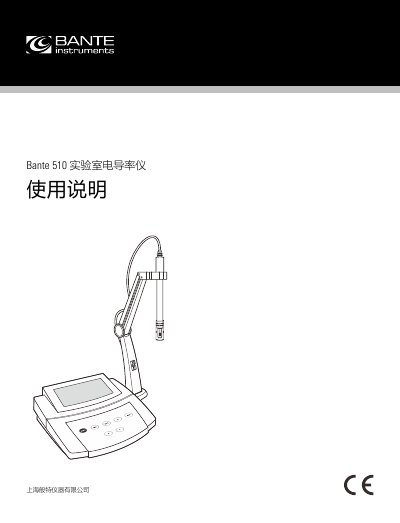
The Bante 510 is a laboratory instrument designed to measure conductivity and Total Dissolved Solids (TDS). It features an LCD display, a membrane keyboard with keys for measurement, calibration, and settings, and supports automatic temperature compensation when connected with the included TP-10K probe. The device allows users to select from three electrode types (CON-0.1, CON-1, CON-10) to match different sample ranges. This manual is written in Chinese.
| Conductivity Measurement Range | 0.01 µS/cm to 200.0 mS/cm |
|---|---|
| Measurement Accuracy (Conductivity) | Full scale ± 1% |
| Calibration Points | 1 to 3 points |
| Temperature Compensation Range | 0 to 100°C, 32 to 212°F |
| TDS Measurement Range | 0.00 to 10.00 ppt (max 200 ppt) |
| Operating Temperature | 0 to 50°C, 32 to 122°F |
| Display Resolution (Conductivity) | 0.001, 0.01, 0.1, 1 |
| Power Requirement | 9V/400mA DC adapter |
Insert the cylinder of the electrode holder into the groove on the base and rotate it 90° to lock.
Connect the TP-10K temperature probe; the ATC icon will appear on the screen to indicate the mode is active.
Check if the connected electrode matches the expected range of the sample and replace it with one that fits.