
The L6258EA is a PWM controlled high current DMOS universal motor driver capable of driving both windings of a bipolar stepper motor or bidirectionally control two DC motors. Each winding has an output current of up to 1.5A, with a wide voltage range of 12V to 40V. It features four quadrant current control, making it ideal for microstepping and DC motor control. The device also offers precision PWM control, no need for recirculation diodes, TTL/CMOS compatible inputs, cross conduction protection, thermal shutdown, and an extended low operating temperature range of -40°C.
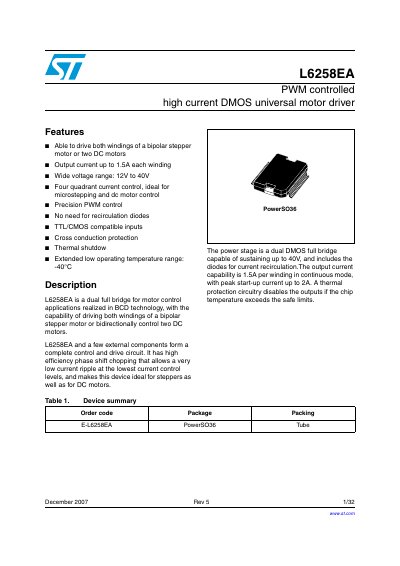
The L6258EA is a dual full bridge motor driver realized in BCD technology. It is capable of driving both windings of a bipolar stepper motor or bidirectionally controlling two DC motors. The device features high efficiency phase shift chopping and includes built-in diodes for current recirculation, eliminating the need for external recirculation diodes.
| Output current (continuous) | 1.5 A |
|---|---|
| Output current (peak) | 2 A |
| Supply voltage range | 12 V to 40 V |
| Operating temperature range | -40°C |
| Technology | BCD |
It can drive both windings of a bipolar stepper motor or bidirectionally control two DC motors.
No, the device includes diodes for current recirculation internally.