
The HMC158 is a GaAs MMIC SMT passive frequency doubler from Hittite with a frequency range of 1.3-4.0GHz, an input drive level of 10-20dBm and an output frequency range of 3.4-8.0GHz. The conversion loss is 15dB and the 3FO and 4FO isolation is 40dB.
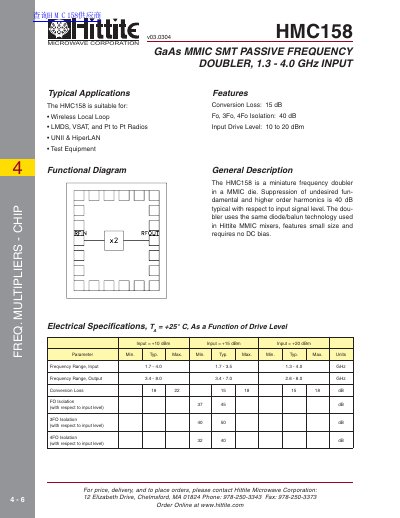
The HMC158 is a miniature GaAs MMIC frequency doubler designed for wireless local loop, LMDS, VSAT, and test equipment applications. It operates with a 1.3 to 4.0 GHz input frequency range and requires no DC bias. The device features suppression of undesired fundamental and higher order harmonics of 40 dB typical with respect to input signal level.
| Conversion Loss | 15 dB |
|---|---|
| Input Drive Level | 10 to 20 dBm |
| Operating Temperature | -55 to +85 °C |
| Storage Temperature | -65 to +150 °C |
Handle the chip along the edges with a vacuum collet or tweezers; do not touch the surface with fingers.
The HMC158 is a miniature frequency doubler in a MMIC die suitable for wireless local loop, LMDS, VSAT, and test equipment applications.
The absolute maximum input drive level for the HMC158 is +27 dBm.
The HMC158 operates between -55 and +85 °C and can be stored between -65 and +150 °C.