
This datasheet introduces the features and characteristics of STMicroelectronics DCPL-WB-02D3, including 50 Ω nominal input / output impedance, wide operating frequency range, low insertion loss, high ESD ruggedness, lead-free CSP, small footprint, and very low profile
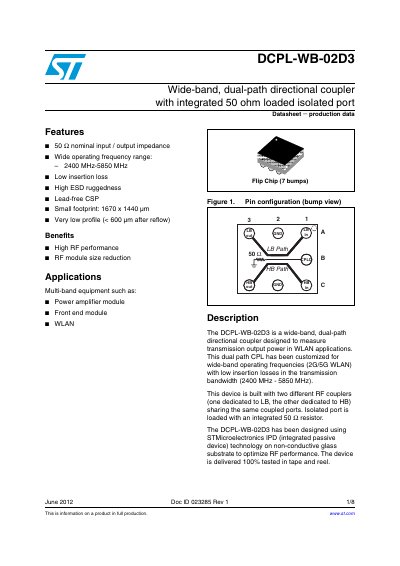
The DCPL-WB-02D3 is a wide-band, dual-path directional coupler designed to measure transmission output power in WLAN applications. It operates across a frequency range of 2400 MHz to 5850 MHz and is built using STMicroelectronics IPD technology on a non-conductive glass substrate. The device features a small footprint and very low profile, making it suitable for RF module size reduction.
| Nominal input / output impedance | 50 Ω |
|---|---|
| Operating frequency range | 2400 MHz - 5850 MHz |
| Pin Input Power RF (CW mode) | 25 dBm |
| Operating temperature | -30 to +85 °C |
| Nominal output impedance | 50 Ω |
| Nominal input impedance | 50 Ω |
| Nominal coupled port impedance | 50 Ω |
| Package type | Flip Chip (7 bumps) |
It is designed for multi-band equipment such as power amplifier modules, front end modules, and WLAN.
The LB path operates from 2400 MHz to 2500 MHz.
The HB path operates from 4900 MHz to 5850 MHz.