
This document introduces Vishay Siliconix's discrete approach to battery charging for cellular phones. The approach utilizes a unique combination of discrete components to meet the needs of small size, high performance, high reliability, and low cost.
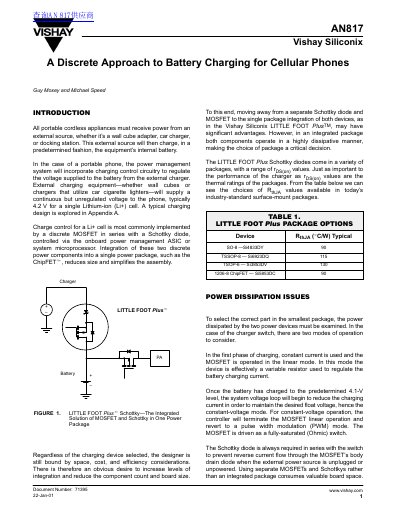
This document explores the discrete approach to battery charging for cellular phones, specifically focusing on the use of a MOSFET in series with a Schottky diode controlled by an onboard power management ASIC. It details the power loss calculations for these components during constant current and constant voltage charging phases.
| Typical charging current range | 400 mA to 700 mA |
|---|---|
| Li+ battery voltage range | 4.1 V to 3.0 V |
| Total discrete power loss (500mA) | 0.79 W |
| ChipFET 1206 RthJA | 90°C/W |
The typical charging currents range from 400 mA to 700 mA.
At a 500-mA charging current, the total discrete power loss is 0.79 W.
The ChipFET 1206 package offers a typical RthJA of 90°C/W.