
The GY240 is a miniature gyroscope produced by Futaba. It has an AVCS automatic yaw trim function and a SMM micro gyroscope sensor that can effectively suppress tail oscillation.
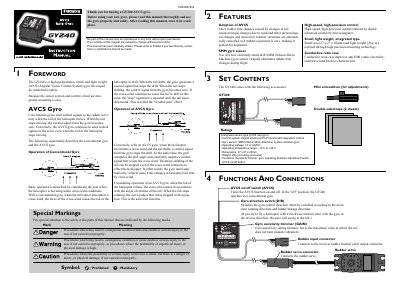
The Futaba GY240 is a high-performance, small, and light weight AVCS (Angular Vector Control System) gyro developed specifically for model helicopters. It features an integrated sensor section and control circuit to simplify mounting, utilizing a conductive resin case for improved anti-EMI characteristics and an SMM (Silicon Micro Machine) gyro sensor for high-speed, high-precision digital advanced PI control.
| Control system | Digital advanced PI (Proportional Integration) control |
|---|---|
| Gyro sensor type | SMM (Silicon Micro Machine) system vibration gyro |
| Operating voltage | +4 to +6VDC |
| Operating temperature range | -10°C to +45°C |
| Dimensions | 27 x 27 x 20mm |
| Weight | 25g (including connector) |
The AVCS gyro automatically cancels rudder trim changes caused by wind and tail reaction torque variations, making tail operation easy for beginners.
When used with a motor helicopter, install the GY240 at least 10cm away from the drive motor to avoid electromagnetic noise interference.
The switch turns the AVCS function on and off; in the 'off' position, the GY240 operates as a conventional gyro.