
The UC3717 is an integrated circuit designed to control and drive the current in one winding of a bipolar stepper motor. It has half-step and full-step capability, built-in fast recovery Schottky commutating diodes, wide range of current control 5-1000mA, wide voltage range 10-45V, designed for unregulated motor supply voltage, current levels can be selected in steps or varied continuously, thermal overload protection.
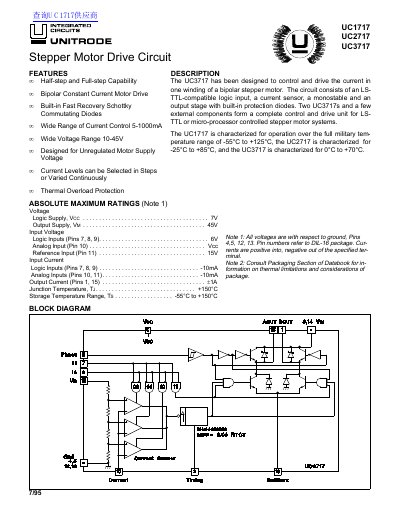
The document describes the UC1717, UC2717, and UC3717 integrated circuits designed to control and drive one winding of a bipolar stepper motor. These circuits include an LS-TTL-compatible logic input, a current sensor, a monostable timer, and an output stage with built-in Schottky commutating diodes for fast recovery.
| Supply Voltage, Vcc | 4.75 to 5.25 V |
|---|---|
| Output Supply, Vu | 10 to 40 V |
| Output Current, Im | 20 to 800 mA |
| Operating Temperature (UC1717) | -55°C to +125°C |
| Operating Temperature (UC3717) | 0°C to +70°C |
The UC1717 is characterized for operation over the full military temperature range of -55°C to +125°C.
Features include half-step and full-step capability, bipolar constant current motor drive, built-in fast recovery Schottky commutating diodes, and a wide range of current control from 5-1000mA.