
The UC3704 is an integrated circuit that contains a complete signal conditioning system for interfacing low-level variable impedance transducers to a digital system. A pair of matched, temperature-compensated current sources are provided for balanced transducer excitation followed by a precision, high-gain comparator. The output of this comparator can be delayed by a user-selectable duration, after which a second comparator will switch complementary outputs separately activated for diagnostic operation and has an optional latch with external reset capability. An added feature is a high current power source useful as a heater driver in differential temperature sensing applications. The UC3704 is designed for 0°C to +70°C environments.
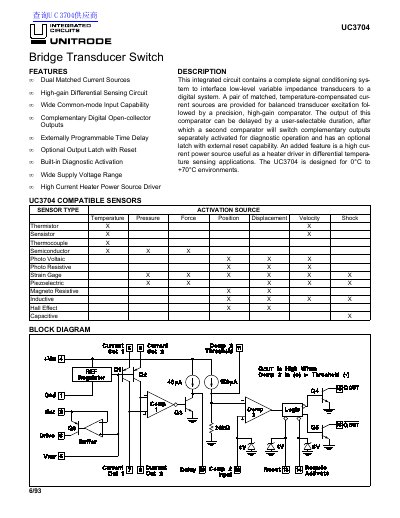
The Unitrode UC3704 is an integrated circuit designed as a complete signal conditioning system to interface low-level variable impedance transducers to a digital system. It features a pair of matched, temperature-compensated current sources for balanced transducer excitation followed by a precision, high-gain comparator.
| Supply Voltage Range | 4.2 to 36 V |
|---|---|
| Operating Junction Temperature | -55°C to +150°C |
| Output Current (each output) | 50mA |
| Buffer Power Source Current | 200mA |
The NPN input transistors require at least 1V of common-mode voltage for accurate operation.