
ST7FLITE0 is a low-end 8-bit MCU with many cost-saving features and it comes with low-cost tools, providing a complete package to reduce both design and final application costs to the absolute minimum.
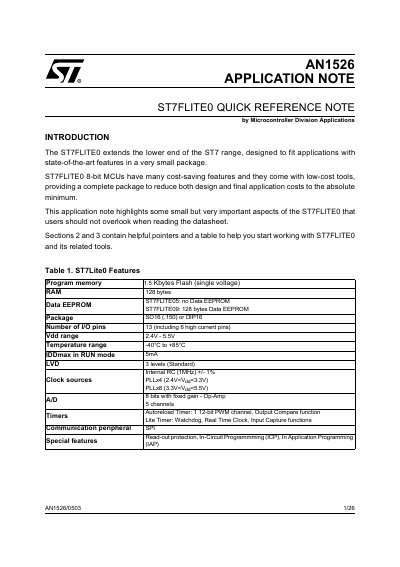
This document serves as a quick reference guide for the ST7FLITEO 8-bit microcontroller, emphasizing its cost-saving features and small package size. It details key advantages such as the high-accuracy internal 1MHz RC oscillator, an 8-bit A/D converter with input voltage amplifier, and true E2PROM data storage with protection against piracy.
The note also covers development tools available for the ST7FLITEO, including software IDEs, simulators, and hardware debugging kits. It provides an easy reference section summarizing technical specifications and programming capabilities like In-Circuit Programming (ICP) and In-Application Programming (IAP).
| Program memory | 1.5 Kbytes Flash (single voltage) |
|---|---|
| RAM | 128 bytes |
| Data EEPROM | ST7FLITEO9: 128 bytes Data EEPROM |
| Package | S016 (.150) or DIP16 |
| Number of I/O pins | 13 (including 6 high current pins) |
| Vdd range | 2.4V - 5.5V |
| Temperature range | -40°C to +85°C |
| IDDmax in RUN mode | 5mA |
| LVD levels | 3 levels (Standard) |
| Internal RC accuracy | 1MHz +/- 1% |
| A/D converter resolution | 8 bits with fixed gain |
| ADC channels | 5 channels |
| Timers | Autoreload Timer: 1 12-bit PWM channel, Output Compare function |
| Communication peripheral | SPI |
| EEPROM Write/Erase cycles | Up to 300K Write/Erase cycles at 25°C |
| ICP programming time | 1kbytes in 160ms |
The ST7FLITEO is a small low-cost microcontroller that embeds many analog functions, allowing users to save board area and the cost of external components like ceramic resonators and reset circuitry.
Yes, it contains an internal RC oscillator with an accuracy of 1% for a given device, temperature, and voltage, which must be calibrated via software.
The internal fixed-gain amplifier (x8) allows the ADC to zoom on low voltage inputs; for Vdd=5V, it can convert from 0V to 250mV.
Yes, it supports In-Circuit Programming (ICP) and In-Application Programming (IAP), allowing programming while the device is plugged into the application.