
This document is about PCI Express, which is a high-speed serial computer expansion bus standard. It was developed by Intel, IBM, Microsoft, Apple, Compaq and HP in 2003. PCI Express supports a variety of applications, including networking, graphics, storage and video. PCI Express is a dual-channel serial bus that uses point-to-point connections and allows bidirectional data transmission over serial links. PCI Express is a high-performance, low-cost, low-power bus standard that is one of the most widely used bus standards in computer systems today.
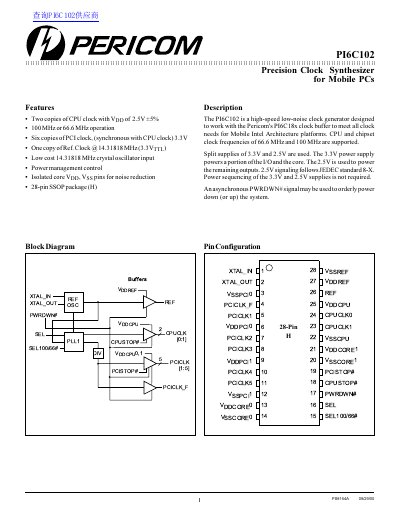
The Pericom PI6C102 is a high-speed, low-noise clock generator designed specifically for Mobile Intel Architecture platforms. It generates two copies of the CPU clock at frequencies of either 66.6 MHz or 100 MHz, along with six synchronous PCI clocks and one reference clock.
The device utilizes split power supplies of 3.3V and 2.5V to drive I/O and core functions respectively, following JEDEC standard 8-X signaling for the 2.5V outputs. It features integrated power management controls including asynchronous PWRDWN# and stop signals for CPU and PCI clocks to facilitate low-power states.
| CPU Clock Frequencies | 66.6 MHz or 100 MHz |
|---|---|
| PCI Clock Copies | Six copies |
| Reference Clock Frequency | 14.31818 MHz |
| Package Type | 28-pin SSOP (H) |
| Operating Temperature Range | 0°C to +70°C |
| Max. 2.5V Supply Consumption (66 MHz) | 100mA |
| Max. 3.3V Supply Consumption (100 MHz) | 170mA |
The device supports CPU and chipset clock frequencies of 66.6 MHz and 100 MHz.
It generates six copies of the PCI clock, which are synchronous with the CPU clock.
The device provides one copy of a reference clock at 14.31818 MHz.