
This document presents a comprehensive protection solution based on companion devices from ST and Cooper Bussmann, experts in wireline networks protection. The document provides necessary information for telecom system card designers to make proper protection choices for wireline networks, which remain the most cost-effective solution for data exchange worldwide.
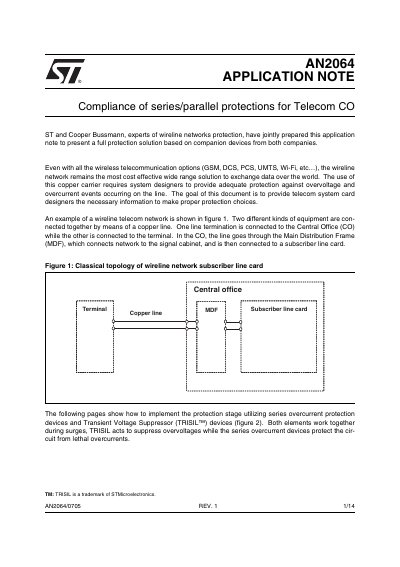
This document presents a protection solution for wireline telecom networks, specifically for Telecom Central Office (CO) subscriber line cards. It details how to implement protection against overvoltage and overcurrent events using a combination of Transient Voltage Suppressor (TRISIL) devices and series overcurrent protection devices like fuses or PTCs. The guide explains the selection criteria for TRISIL devices based on normal operating modes and suppression modes, referencing standards such as ITU-T K20 and Telcordia GR-1089.
The note provides specific circuit topologies for both analog and digital (ADSL) applications, illustrating how to arrange the primary and secondary protection stages. It compares PTCs and fuses for series protection, highlighting their respective advantages and drawbacks regarding resistance and resettable features. Finally, it offers a specific example for US market applications, recommending the SMP100MC-270 TRISIL device and outlining its electrical parameters.
| Minimum breakdown voltage (US) | > 270V |
|---|---|
| Maximum leakage current | < 1mA |
| Current capability (10/1000us) | > 100A |
| Current capability (2/10us) | > 500A |
| Recommended TRISIL Model (US) | SMP100MC-270 |
The two main disturbances are those linked to atmospheric effects and those produced by contact or proximity with the 50/60Hz mains network.
Series resistors are forbidden in ADSL systems because they are used for line longitudinal balancing, which is not permitted in digital networks.