
This document presents a protection solution for single battery voltage SLICs in new networks in the US market. It describes the structure of modern telecom networks and the application of SLICs in these networks. The document proposes a complete protection solution for short line SLICs.
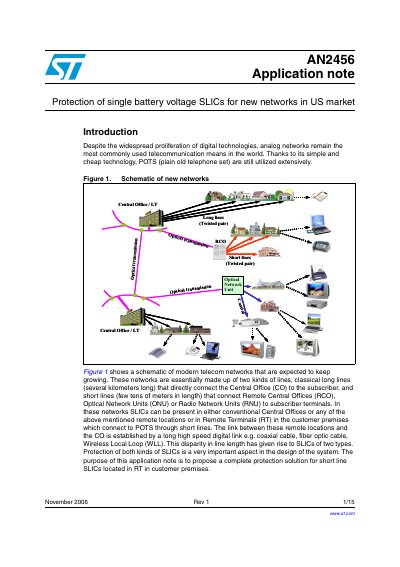
The document addresses the need for protection in short line Subscriber Line Interface Circuits (SLICs) located in Remote Terminals (RT) within customer premises. It identifies lightning surges and power crossing as primary disturbances and references the Telcordia GR1089 standard for testing requirements.
The note details a protection concept utilizing the LCP152xx crowbar device to handle lightning surges, often in conjunction with fuses for power crossing protection. It provides a specific circuit example using the STLC3055N SLIC and the LCP1521S protector, including recommended PCB layout practices and test results.
The device operates as a crowbar that bypasses surge current to ground when a negative voltage exceeds a specific threshold, then switches off once the current drops below the holding level.
The optimized value for the capacitor connected between the gate and ground is 220 nF.
The first level requires the equipment to continue operating properly, while the second level allows damage provided the equipment does not become a fire or electrical hazard.