
This document describes a new device introduced by ST Microelectronics called SaTCR-1 (Satellite Channel Router), which is able to translate a transponder to any location in the satellite bandwidth (950-2150 MHz). Multiple SaTCR devices coupled with band-pass filters and RF matrix allow to combine transponders from different polarizations and bands on a single coaxial cable. The purpose of this document is to describe the AN2056 protocol extension used to control a LNB based on SCR technology.
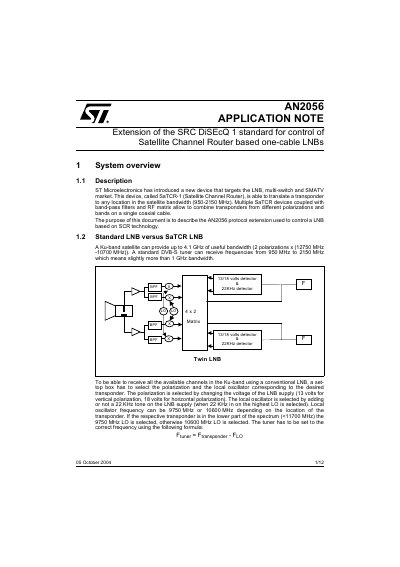
STMicroelectronics has introduced the SaTCR-1 (Satellite Channel Router) device for the LNB, multi-switch, and SMATV market. This document details an application note protocol extension designed to control a Low Noise Block (LNB) based on SCR technology. It explains how standard DVB-S tuners can receive frequencies from 950 MHz to 2150 MHz using this new device coupled with band-pass filters.
The guide covers the differences between standard LNBs and SaTCR LNBs, specifically regarding polarization selection and local oscillator (LO) frequency translation. It provides instructions for setting up the system manually or automatically via auto-detection routines within a set-top box. Furthermore, it outlines software architecture requirements for implementing DiSEqC commands to manage multiple set-top boxes connected to the same cable.
| Frequency Range (Standard DVB-S tuner) | 950 MHz to 2150 MHz |
|---|---|
| Ku-band Satellite Bandwidth | up to 4.1 GHz |
| Vertical Polarization Voltage | 13 volts |
| Horizontal Polarization Voltage | 18 volts |
| 22 KHz Tone Function | Selects highest LO frequency |
Each set-top box tuner should be allocated a dedicated SaTCR device to avoid conflicts.
Vertical polarization is selected using 13 volts, while horizontal polarization is selected using 18 volts.
A 22 KHz tone is added to the LNB supply to select the highest local oscillator.
The tuner low-pass filter bandwidth should be less than 50 MHz to ensure proper tone detection.