
AN1301 APPLICATION NOTE introduces the features and characteristics of STE100P product, including 3.3V low power operation, can be configured for full duplex or half duplex, provide auto negotiation, parallel detection or manual control, MLT-3 transceiver and DC restoration function etc.
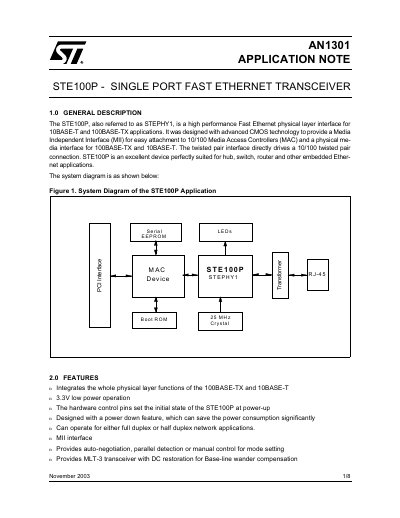
The document describes the STE100P (also referred to as STEPHY1), a high-performance Fast Ethernet physical layer interface designed for 10BASE-T and 100BASE-TX applications. It integrates physical layer functions and features an MII interface for connection to Media Access Controllers.
Key sections include design and layout guidelines for power, ground planes, and differential signals, as well as specific circuitry recommendations for the transmit and receive twisted pair interfaces. The note also details crystal requirements, LED pin characteristics, and provides a typical application schematic using DIP switches for configuration.
The manual recommends using bulk capacitors between 10 and 22uF.
The ferrite bead must have a maximum current rating of at least 250mA.
The line has a nominal impedance of 100 ohm.