
This application note describes the layout and mechanical design guidelines used for touch sensing applications.
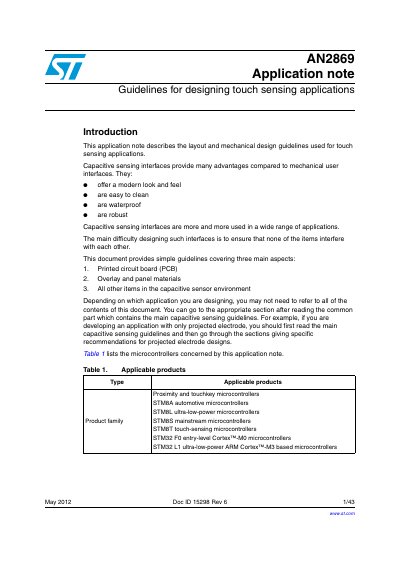
This document outlines the layout and mechanical design guidelines necessary for developing touch sensing applications. It covers three main aspects: Printed Circuit Board (PCB) design, overlay and panel materials, and environmental factors that may interfere with sensor performance.
The note details four specific acquisition principles available in STMicroelectronics product families: RC acquisition, charge transfer acquisition, surface ProxSense™ acquisition, and projected ProxSense™ acquisition. It provides specific recommendations for designing surface electrodes (touchkeys, linear, rotary) and projected sensors.
The note applies to STM8A, STM8S, STM8L, STM8T14x, STM8TL5x, and various STM32 FO and L1 series microcontrollers.
The document lists STMBA automotive, STMBL ultra-low-power, STM8S mainstream, STME8T touch-sensing, and STM32 FO entry-level Cortex-M0 or L1 ultra-low-power ARM Cortex-M3 based microcontrollers as applicable products.
Capacitive sensing interfaces offer a modern look and feel, are easy to clean, waterproof, and robust.
The main difficulty is ensuring that none of the items interfere with each other.