
This application note describes how to achieve high accuracy over a wide temperature range using ST's M41T82-83-93 series of RTCs, by combining the characteristics of the crystals used. This is accomplished by first measuring the frequency and then using both the analog and digital calibration features of these devices.
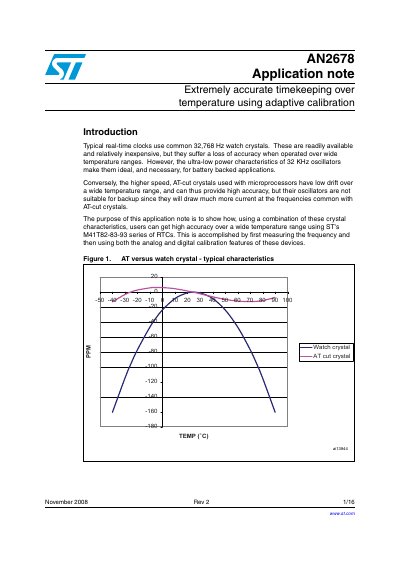
The document explains that while typical 32 kHz watch crystals lose accuracy at extreme temperatures, they are ideal for low-power battery backup. Conversely, AT-cut crystals offer high temperature stability but consume too much power for backup applications.
ST's M41T82-83-93 series RTCs combine the benefits of both crystal types by allowing periodic calibration via a microprocessor. The note details an initial analog calibration procedure performed at room temperature to minimize oscillator error, followed by occasional digital calibration updates during normal operation.
| Oscillator base frequency | 32,768 Hz |
|---|---|
| Analog calibration range (per capacitor) | 7 pF to 34.75 pF |
| Equivalent load capacitance range | 3.5 pF to 17.4 pF |
To show how users can get high accuracy over a wide temperature range using ST's M41T82-83-93 series RTCs.
The analog calibration circuit is adjusted at room temperature in a closed loop fashion until the error is minimized.
During normal operation, the microprocessor periodically measures the error and writes adjustments to the digital calibration circuit.