
This document describes how to initialize variables in C using the Analog Devices' 21xx C compiler.
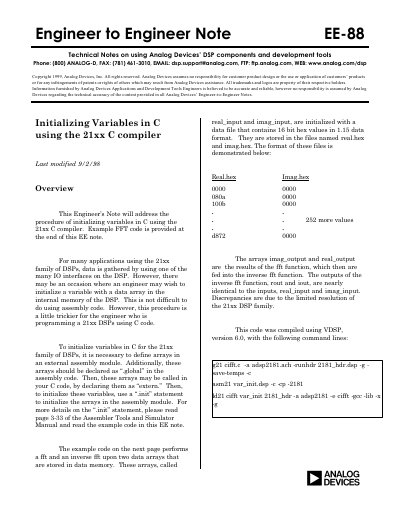
This document is an Engineer-to-Engineer Note (EE-88) from Analog Devices regarding the use of their DSP components and development tools. It specifically addresses the procedure for initializing variables in C using the 21xx C compiler, noting that this process is more complex than using assembly code. The note explains that to initialize variables in C for the 21xx family of DSPs, it is necessary to define arrays in an external assembly module, declare them as ".global" in the assembly code, and then declare them as "extern" in the C code.
The files containing hex values for initializing variables must be in 1.15 data format.
The provided example code performs an FFT and inverse FFT on an array of 256 data points.
Discrepancies are caused by the limited resolution of the 21xx DSP family.