
The AD9888 is a complete 8-bit, 205 MSPS analog interface optimized for capturing RGB graphics signals from personal computers and workstations. Its 205 MSPS encode rate capability and 500 MHz full-power bandwidth support display resolutions up to UXGA (1600 x 1200 at 75 Hz) and all HDTV formats. The AD9888 fully integrates triple 8-bit/205 MSPS ADCs, on-chip PLL to generate a pixel clock from HSYNC and COAST, mid-scale clamping, and programmable gain, offset, and clamp controls. The AD9888 has the perfor- mance, features, and functionality to enable high- resolution display system designers to achieve the best possible image quality.
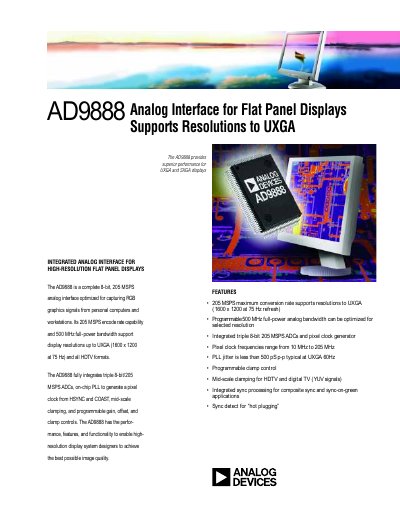
The AD9888 is a complete 8-bit, 205 MSPS analog interface optimized for capturing RGB graphics signals from personal computers and workstations. It supports display resolutions up to UXGA (1600 x 1200 at 75 Hz) and all HDTV formats. The device fully integrates triple 8-bit/205 MSPS ADCs, an on-chip PLL to generate a pixel clock from HSYNC and VSYNC, mid-scale clamping, and programmable gain, offset, and clamp controls.
| Maximum conversion rate | 205 MSPS |
|---|---|
| Package type | 128-lead MQFP |
| Output voltage range | 2.5 V to 3.3 V |
| Power consumption (UXGA) | Less than 1W |
| Analog bandwidth | 500 MHz |
| PLL clock jitter (UXGA 60 Hz) | Less than 500 pS p-p |
The maximum conversion rate is 205 MSPS.
It supports resolutions up to UXGA (1600 x 1200 at 75 Hz) and all HDTV formats.
The pixel clock is generated on-chip from HSYNC and VSYNC inputs.