
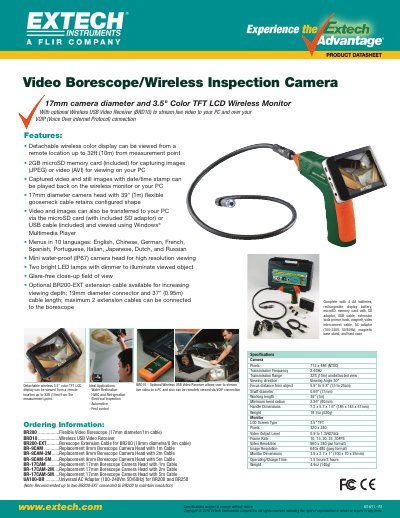
Extech BR200 is a 17mm camera diameter and 3.5 inch Color TFT LCD Wireless Monitor with optional Wireless USB Video Receiver (BRD10) to stream live video to your PC and over your VOIP (Voice Over Internet Protocol) connection.
The Extech Model DV30 is an AC voltage detector designed for indoor use. Before operating the device, users must read the safety precautions to avoid damage or injury. The meter features double insulation and requires four LR44 batteries for power.
To operate the detector, turn the unit on using the On/Off-Sensitivity switch and adjust the sensitivity setting until the beeper sounds when near a conductor. Users should verify proper operation by testing the detector on a known live circuit before use to ensure safety.
| Voltage Sensitivity Range | 12V to 600VAC (50 to 500Hz) |
|---|---|
| Operating Temperature | -10°C to 50°C (14 to 122°F) |
| Storage Temperature | -20 to 60°C (-4 to 140°F) |
| Relative Humidity | <80% |
| Operating Altitude | 7000 ft. (2000 meters) maximum. |
| Battery Type | 4 LR44 batteries |
| Dimensions/Weight | 155x28x25mm (6.3x0.75x1") / 42g |
| Safety Standard | IEC 1010 Category Ill 600V |
The detector operates with a voltage sensitivity from 12V to 600VAC at frequencies between 50 and 500Hz.
The device requires four LR44 batteries to function.
No, the safety specifications state that this meter is intended strictly for indoor use.