
This document is the technical manual of NJL5175K. It introduces the features and characteristics of the product.
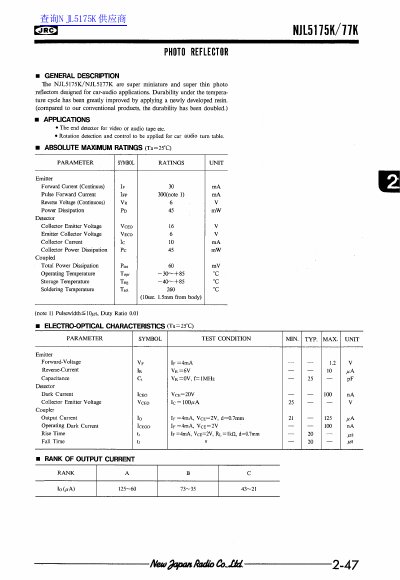
The NJL5175K and NJL5177K are super miniature and super thin photo reflectors designed specifically for car-audio applications. These devices feature improved durability under temperature cycles due to a newly developed resin, offering double the durability of conventional products. They are suitable for applications such as end detectors for video or audio tapes and rotation detection for car audio turntables.
The document provides absolute maximum ratings, electro-optical characteristics, typical performance curves, and detailed handling precautions. Key specifications include a forward current of 30 mA, a reverse voltage of 6 V, and an operating temperature range of -30°C to +85°C. The datasheet also outlines specific soldering and cleaning procedures to prevent damage to the device lens and resin.
| Forward Current (Continuous) | 30 mA |
|---|---|
| Reverse Voltage (Continuous) | 6 V |
| Power Dissipation | 45 mW |
| Operating Temperature | -30~+85 °C |
| Soldering Temperature | 260 °C |
They are designed for car-audio applications, such as end detectors for video or audio tapes and rotation detection for car audio turntables.
The maximum soldering temperature is 260°C, with a recommended time of less than 1.5 seconds.
It is preferable to use less reactive solvents like Methyl Alcohol or Isopropyl Alcohol to avoid attacking the lens surface.