
This document is the installation and operations manual for the D380-72-2LL microinverter.
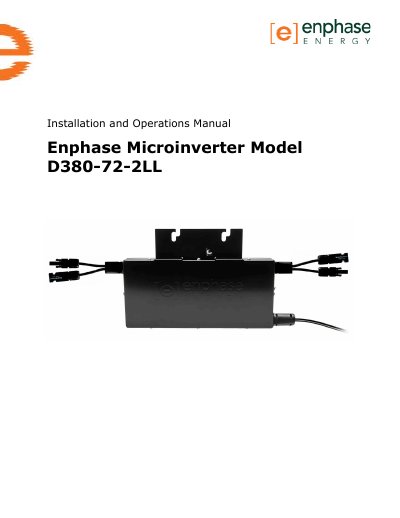
This manual provides instructions for the installation and operation of the Enphase D380-72-2LL TwinPack microinverter. It details the system components, including the microinverter, Envoy Communications Gateway, and Enlighten monitoring system, and explains how the D380 maximizes energy production by controlling each PV module individually. The document covers planning considerations, such as compatibility with 60 and 72-cell PV modules and 240VAC or 208VAC services.
| Compatible PV Module Cell Count | 60 and 72 cell |
|---|---|
| Operating Temperature | 65°C (150°F) |
| Environmental Rating | NEMA6 |
| Maximum D380s per 20 amp AC branch circuit (240V) | 10 |
| Maximum D380s per 20 amp AC branch circuit (208V) | 15 |
No, users should not attempt to repair the microinverter as it contains no user-serviceable parts.
The microinverter is designed to operate at full power at ambient temperatures as high as 65°C (150°F).
The D380 Microinverters are compatible with most 60 and 72-cell PV module configurations.