
The DS485 is a low-power transceiver for RS-485 and RS-422 communication. It features low quiescent current, short-circuit current limitation, and thermal shutdown circuitry for protection. Both the driver and receiver support TRI-STATE outputs, and the receiver has a failsafe feature for high-level output when the input is open circuit.
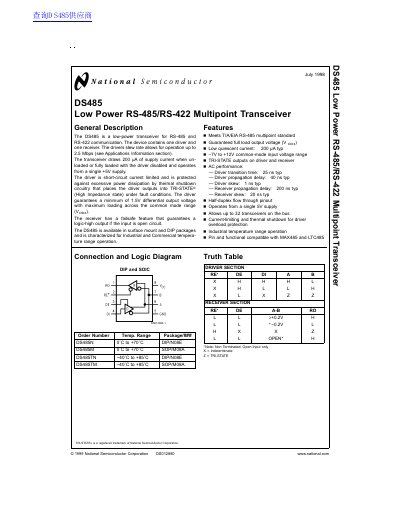
The DS485 is a low-power transceiver designed for RS-485 and RS-422 communication applications. It contains one driver and one receiver, drawing 200 µA of supply current when unloaded or fully loaded with the driver disabled, and operates from a single +5V supply. The device features short-circuit current limiting and thermal shutdown circuitry to protect against excessive power dissipation.
| Quiescent Current | 200 µA typ |
|---|---|
| Common-Mode Input Voltage Range | -7V to +12V |
| Maximum Data Rate | 2.5 Mbps |
The DS485 allows for operation up to 2.5 Mbps based on a ratio of driver transition time to the unit interval of 10%.
The DS485 allows up to 32 transceivers on the bus as it provides a standard unit load.
Yes, the driver is short-circuit current limited and protected by thermal shutdown circuitry that places outputs into TRI-STATE under fault conditions.