
R1172x Series 1A LDO is a CMOS-based linear regulator featuring 1A output. CMOS process provides both high output current and low supply current. The dropout voltage is significantly lower than bipolar regulators. R1172x handles low voltage with an input voltage from 1.4V and output voltage from 0.8V. Accordingly, the device supports highly integrated, low voltage-driven LSI as a rear stage of the DC/DC converter. The CE pin can switch the regulator into standby mode. In addition to a fold-back protection circuit built into conventional LDO regulators, R1172x has a thermal shutdown circuit and inrush current limit circuit. Ceramic capacitors can be used
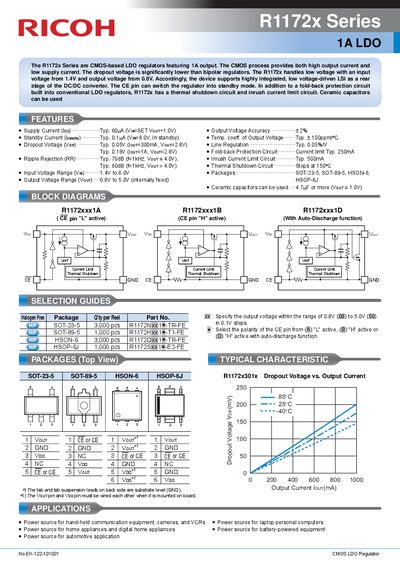
The R1172x Series are CMOS-based LDO regulators featuring 1A output current. The CMOS process provides high output current and low supply current, with a dropout voltage significantly lower than bipolar regulators. The device supports low voltage operation with an input voltage from 1.4V and an output voltage from 0.8V.
| Output Current | 1A |
|---|---|
| Input Voltage Range | 1.4V to 6.0V |
| Output Voltage Range | 0.8V to 5.0V |
| Standby Current | Typ. 0.1pA |
| Dropout Voltage | Typ. 0.05V to 0.18V |
| Ripple Rejection | Typ. 70dB |
| Packages | SOT-23-5, SOT-89-5, HSON-6, HSOP-6J |
Yes, ceramic capacitors can be used with a capacitance of 4.7uF or more.
The typical temperature coefficient of the output voltage is +100ppm/°C.