
This document introduces the features and performance of ZORBAX Eclipse XDB HPLC columns, including excellent peak shape for different compounds, high performance over a wide pH range, and rugged and reproducible chromatography from column-to-column and lot-to-lot.
This document provides a technical overview of the Agilent ZORBAX Eclipse XDB family of HPLC columns. It explains why these columns are designed to solve separation challenges by providing excellent peak shape for basic, acidic, and neutral compounds across a wide pH range (3-9). The text details how the eXtra Dense Bonding (XDB) technology and double endcapping process eliminate undesirable interactions with polar solutes.
The document further discusses the long column life provided by the proprietary 'sol-gel' silica particles, which are thick-walled and resistant to dissolution at intermediate pH. It also covers the various selectivity options available in the family, including C18, C8, Phenyl, and CN bonded phases, demonstrating how different phases can reduce analysis time while maintaining resolution.
| Particle Size | 5, 3.5, and 1.8-um |
|---|---|
| Maximum Pressure Tolerance | 6000 psi/400 bar |
| Bonded Phases Available | C18, C8, Phenyl and CN |
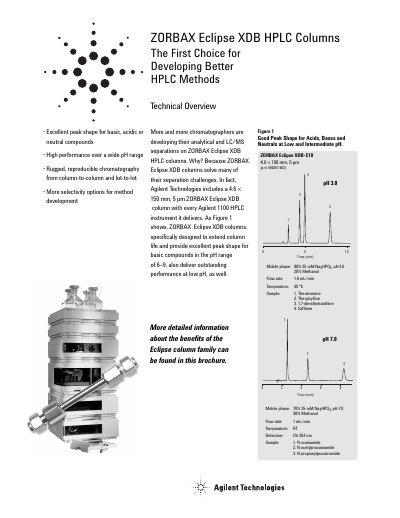
They provide excellent peak shape for basic compounds in the pH range of 6-9, as well as outstanding performance at low pH.
The columns use eXtra Dense Bonding (XDB) and double endcapping to virtually eliminate undesirable interactions between polar solutes and the silica surface.
They use patented 'sol-gel' silica particles which form thick, hard-walled structures to resist dissolution and crushing under high pressure.