
This document describes the technical background, the workflow and the performance of the Protein 200 HT-2 assay.
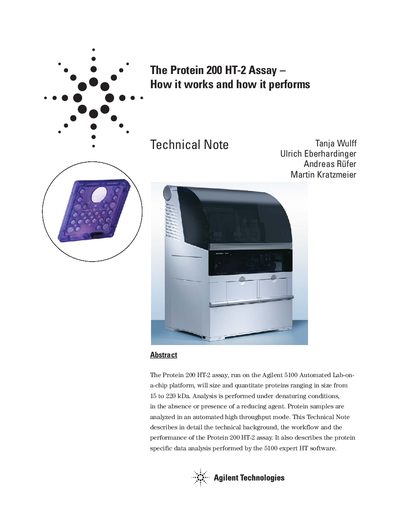
The Protein 200 HT-2 assay is run on the Agilent 5100 Automated Lab-on-a-Chip platform (5100 ALP) to size and quantitate proteins ranging from 15 to 220 kDa. Analysis is performed under denaturing conditions, with or without a reducing agent, in an automated high-throughput mode using standard 96-well plates.
The assay utilizes the Protein 200 HT-2 chip and reagent kit. Proteins are separated sequentially through a sieving polymer in the chip's separation channel and detected by laser-induced fluorescence. The 5100 expert HT software generates a standard curve using a protein ladder to calculate molecular weights and concentrations based on migration time and fluorescence intensity.
| Sizing range | 15 to 220 kDa |
|---|---|
| Chip part number | G3011-87300 |
| Reagent kit part number | G3011-68750 |
| Instrument part number | G3002A |
| Sample volume | 4 pL |
| Denaturation temperature | 95 °C |
| Ladder protein sizes | 15, 28, 46, 63, 95, 150 kDa |
| Upper marker size | 240 kDa |
The assay allows for sizing of proteins ranging from 15 to 220 kDa.
Yes, analysis is performed under denaturing conditions in the absence or presence of a reducing agent.
The upper limit is determined by the upper marker being at 240 kDa.