
Describes the composition of the Electro-osmotic flow (EOF) in electrophoresis, explains the impact of EOF on the migration time of electrophoresis, and how to use mobility to improve the reproducibility of electrophoresis
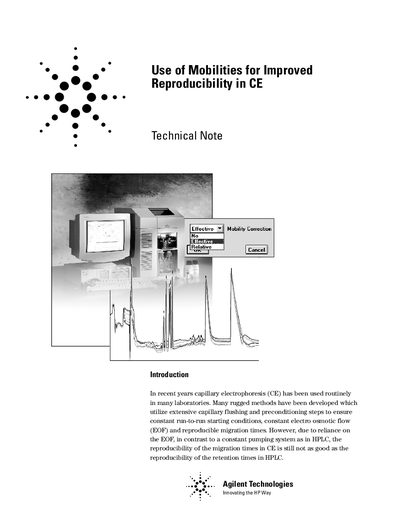
This document describes the use of mobility correction features in Agilent ChemStation software revision A.06 to improve the reproducibility of migration times in capillary electrophoresis (CE). It addresses the variability of electroosmotic flow (EOF) and explains how calculating true effective mobilities eliminates EOF-induced shifts, allowing for better comparison of analytical results across different runs, capillaries, and batches.
The guide details the procedure for performing effective mobility correction, which requires an EOF marker and stored experimental parameters like voltage and capillary dimensions. It also covers relative mobility correction, which does not require an EOF marker or specific instrument parameters. The text includes instructions on selecting reference peaks, entering settings in the software, and interpreting the resulting mobility reports.
| Software Revision | A.06 |
|---|---|
| Feature Name | Effective Mobility Correction |
It eliminates the EOF portion of the apparent mobility, enabling the user to compare a solely sample-related parameter and significantly improving run-to-run reproducibility.
Yes, an EOF marker is required to determine the true effective mobility values for comparison with subsequent runs.
No, relative mobility correction does not require an EOF marker, voltage values, or capillary dimensions.