
This product is an open source three-dimensional reconstruction system based on the open source ROS framework. The system uses RGB-D cameras to collect depth images and RGB images, and registers and fuses depth images and RGB images to obtain aligned depth images and RGB images. Then, the point cloud segmentation algorithm is used to segment the three-dimensional point cloud data, and the object and background are segmented. Then, the object recognition algorithm is used to recognize the segmented objects, and the category and 3D coordinates of the objects are recognized. Finally, the visual SLAM algorithm is used to perform SLAM mapping on the 3D point cloud data to obtain a 3D map. The system can realize real-time online three-dimensional reconstruction, can identify objects in the scene, and can perform SLAM mapping of the scene.
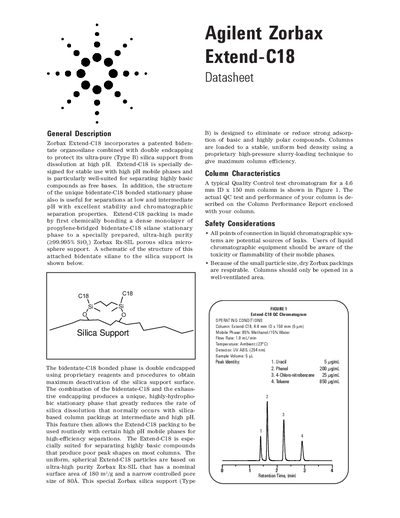
The Agilent Extend-C18 is a high-performance liquid chromatography (HPLC) column packing designed for stable use with high pH mobile phases. It features a patented bidentate organosilane combined with double endcapping to protect the ultra-pure silica support from dissolution. This structure makes it particularly well-suited for separating highly basic compounds as free bases, providing excellent stability and chromatographic separation properties at low, intermediate, and high pH levels.
The datasheet provides detailed operating conditions, including recommended mobile phases, flow rates, and temperature limits. It also includes specific guidelines for instrument compatibility, noting the need for Tefzel rotor seals in Agilent autosamplers and manual injectors when operating above pH 9.5 to prevent seal degradation. Safety considerations regarding the toxicity of mobile phases and the respirable nature of dry packing are also addressed.
| Particle Support | Ultra-high purity Zorbax Rx-SIL porous silica micro-sphere |
|---|---|
| Pore Size | 80 Angstroms |
| Carbon Content | 12% |
| Maximum Operating Temperature | 60 C |
| Maximum Operating Pressure | 400 bar (6000 psi) |
| Optimum Operating pH Range | pH 2 - 11.5 |
The column can be used up to pH 11.5 with good results, provided organic buffers are used and the temperature does not exceed 40 C.
Yes, it is especially well-suited for separating highly basic compounds as free bases, which often produce poor peak shapes on other columns.