
This report provides a detailed analysis of the in-vehicle gateway in the automotive electronic system, introducing the function, type, selection, development, verification, application, etc. of the gateway, and predicting the development trend in the future.
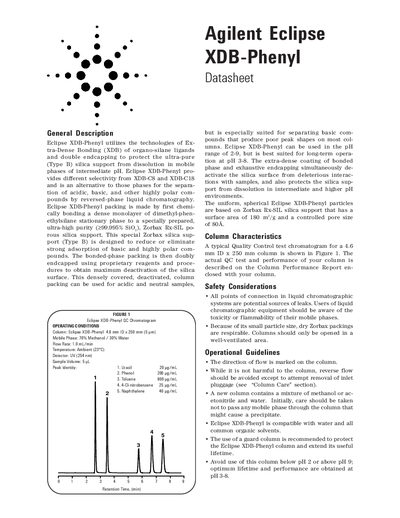
The Agilent Eclipse XDB-Phenyl is a reversed-phase liquid chromatography column utilizing Extra-Dense Bonding (XDB) technology. It features a dimethyl-phenethylsilane stationary phase bonded to ultra-pure Zorbax Rx-SIL porous silica support, designed to reduce strong adsorption of basic and highly polar compounds. The column is doubly endcapped to deactivate the silica surface and protect against dissolution in intermediate pH mobile phases.
| Particle Type | Uniform, spherical |
|---|---|
| Silica Support | Zorbax Rx-SIL |
| Pore Size | 80A |
| Maximum Operating Pressure | 400 bar (6000 psi) |
| Maximum Operating Temperature | 60°C |
| Recommended pH Range | 3-8 |
| Inlet Frit Porosity | 2 um |
The column is best suited for long-term operation at pH 3-8.
The maximum recommended operating temperature is 60°C.
The column uses Zorbax Rx-SIL porous silica support.
Yes, the use of a guard column is recommended to protect the column and extend its useful lifetime.