
LT1510/LT1510-5 is a simple and efficient solution for fast-charging modern rechargeable batteries including lithium-ion (Li-Ion), nickel-metal-hydride (NiMH)*, and nickel-cadmium (NiCd)* that require constant-current and/or constant-voltage charging. It features an internal switch capable of delivering 1.5A DC current (2A peak current). The charging current programming is simplified with a 0.1Ω onboard current sense resistor, requiring only one resistor or a programming current from a DAC to set the full charging current (1.5A) within 5% accuracy. With 0.5% reference voltage accuracy, the LT1510 meets the critical constant-voltage charging requirement for lithium cells. It can charge batteries ranging from 2V to 20V, and does not require ground sensing of current, allowing the battery's negative terminal to be tied directly to ground. The chip operates with a saturating switch running at 200kHz (500kHz for LT1510-5), providing high charging efficiency and small inductor size. A blocking diode is not needed between the chip and the battery as the chip goes into sleep mode and drains only 3µA when the wall adaptor is unplugged. Soft start and shutdown features are also included.
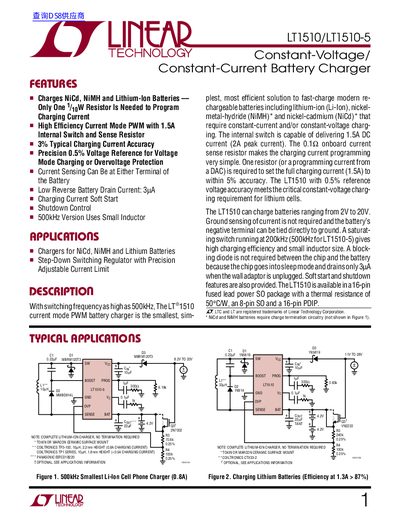
The LT1510 is a current mode PWM battery charger designed to charge Nickel-Cadmium (NiCd), Nickel-Metal-Hydride (NiMH), and Lithium-Ion batteries. It features high efficiency with an internal 1.5A switch and requires only one external resistor to program the charging current.
The device operates at switching frequencies up to 500kHz, allowing for small inductor sizes. Key features include a precision 0.5% voltage reference, low reverse battery drain of 3uA, soft start capability, and shutdown control. It is available in various packages including SO, PDIP, and SSOP.
| Charging Current (Max) | 1.5A DC (2A peak) |
|---|---|
| Switching Frequency | Up to 500kHz |
| Battery Voltage Range | 2V to 20V |
| Reverse Battery Drain Current | 3uA |
| Reference Voltage Accuracy | 0.5% |
It charges NiCd, NiMH, and Lithium-Ion batteries.
Only one external resistor is needed to program the charging current.