
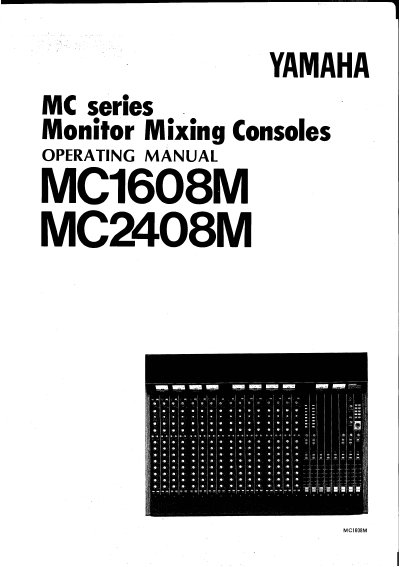
This manual provides operating instructions for the Yamaha MC1608M and MC2408M monitor mixing consoles. These versatile, portable, and reliable units are designed to provide flexible and efficient stage monitoring for performing musicians. The consoles offer eight different monitor mixes via eight busses controlled by compact rotary controls, along with two auxiliary channels for various purposes such as patching in echo or signal processing units, feeding a tape deck, or providing monitor mixes for the operator and stage manager.
The document details the operation of the front panel sections, including input channels with pad, gain, and equalizer controls, as well as auxiliary input and master output sections. It also covers rear panel connections, installation procedures, and operating tips. The manual includes system examples, a block diagram, a level diagram, and detailed input/output and general specifications.
| High Frequency EQ Range | 10 kHz shelving type |
|---|---|
| Mid Frequency EQ Range | 350 Hz — 5 kHz peaking type |
| Low Frequency EQ Range | 100 Hz shelving type |
| EQ Gain | +/- 15 dB |
| Gain Control Range | -20 & -60 dB |
| Pad Attenuation | 20dB |
| High Pass Filter Frequency | 80Hz |
| High Pass Filter Roll-off | 18 dB/octave |
The switch reverses the phase of the XLR connectors, making pin 2 negative and pin 3 positive when depressed.
Depressing the pad switch inserts a 20dB attenuator before the head amplifier to handle particularly high signal levels.
The switch allows a single selected input channel or a group of input channels to be monitored through the operator's headphones or monitor speaker.
Depressing this switch inserts a filter on the master output below 80Hz to roll off low end frequencies, reducing wind noise and hum.