
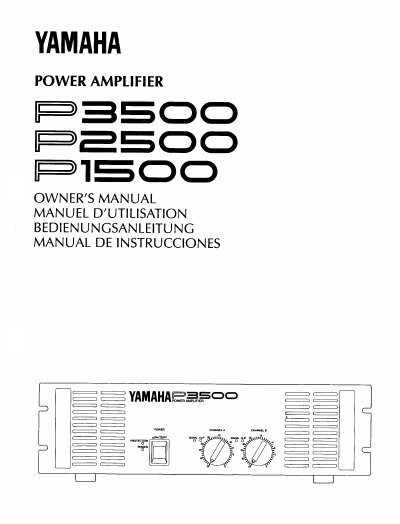
The Yamaha P3500, P2500, and P1500 are power amplifiers with the same feature set; the manual states that their only difference is output power. Input connections are balanced XLR-type jacks, balanced 1/4-inch phone jacks, and a barrier strip, while outputs are 5-way binding posts and a barrier strip.
The owner's manual covers precautions, operation, stereo and bridge modes, speaker connection and impedance, portable rack mounting, troubleshooting, specifications, dimensions, and performance graphs. It also describes protection systems for soft-start power on/off, output muting, DC protection, and heat sink overheat, plus twin two-speed low-noise fans.
| P3500 output power | 350 W + 350 W into 8 Ω per channel in stereo; 1000 W into 8 Ω in mono |
|---|---|
| P2500 output power | 250 W + 250 W into 8 Ω per channel in stereo; 700 W into 8 Ω in mono |
| P1500 output power | 150 W + 150 W into 8 Ω per channel in stereo; 420 W into 8 Ω in mono |
| Stereo minimum speaker impedance | 4 Ω per channel |
| Bridge minimum speaker impedance | 8 Ω |
| Input connectors | Balanced XLR-type jacks, balanced 1/4-inch phone jacks, and barrier strip |
| Output connectors | 5-way binding posts and barrier strip |
| Input attenuators | 41-step detented, 0 dB to -∞ |
| Fans | Twin two-speed low-noise fans |
The manual states that their only difference is output power; their feature set is the same.
It supports Stereo and Bridge modes. In Stereo mode channels A and B operate independently; in Bridge mode they work as one mono amplifier.
The minimum speaker impedance in Bridge mode is 8 Ω.
It shows the status of the protection systems, which include soft-start power on/off, output muting, DC protection, and heat sink overheat. When a protection system is active, it lights and no sound is output.