
The LTC1775 is a synchronous step-down switching regulator controller that drives external N-channel power MOSFETs using few external components. It features current mode control, no sense resistor required, wide voltage range, and programmable fixed frequency, etc.
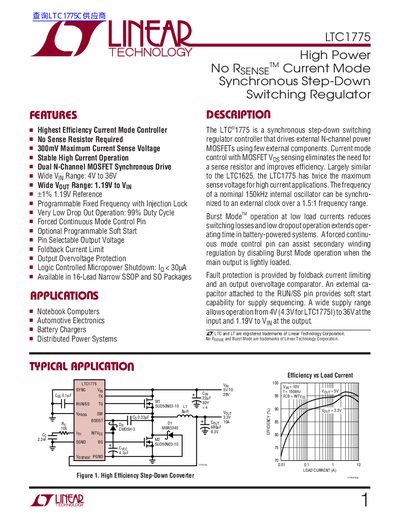
The LTC1775 is a synchronous step-down switching regulator controller designed to drive external N-channel power MOSFETs. It utilizes current mode control with MOSFET Vds sensing, which eliminates the need for an external sense resistor and improves efficiency. The device supports a wide input voltage range from 4V to 36V and offers features such as cycle burst mode operation at low loads and programmable soft start.
| Input Voltage Range | 4V to 36V |
|---|---|
| Output Voltage Range | 1.19V to Viy |
| Maximum Current Sense Voltage | 300mV |
| Shutdown Supply Current | < 30uA |
| Operating Temperature Range (Industrial) | -40°C to 85°C |
The maximum input voltage range is 36V.
The device supports a maximum current sense voltage of 300mV.
The internal oscillator operates at a typical frequency of 150kHz with the SYNC pin open.
Industrial grade parts require a minimum input supply voltage of 4.3V at 40°C.