
AIC809/AIC810 3-Pin Microprocessor Reset Circuits are low-power microprocessor (µP) supervisory circuits used to monitor power supplies in µP and digital systems. They provide applications with benefits of circuit reliability and low cost by eliminating external components. These devices perform as valid singles in applications with Vcc ranging from 6.0V down to 0.9V. The reset signal lasts for a minimum period of 140ms whenever VCC supply voltage falls below preset threshold. Both AIC809 and AIC810 were designed with a reset comparator to help identify invalid signals, which last less than 140ms. The only difference between them is that they have an active-low RESET output and active-high RESET output, respectively. Low supply current (1µA) makes AIC809/AIC810 ideal for applications requiring low power consumption, such as notebook computers, digital still cameras, PDAs, and critical microprocessor monitoring.
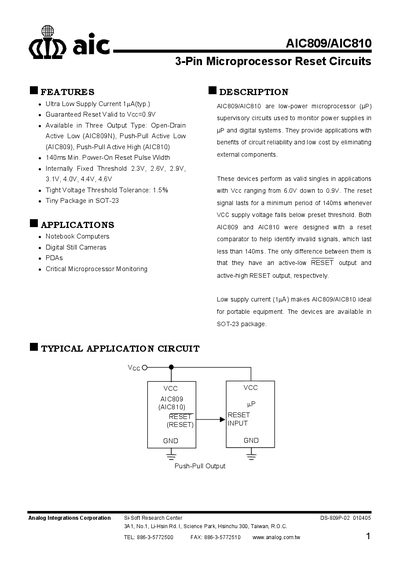
The AIC809/AIC810 are low-power microprocessor (uP) supervisory circuits designed to monitor power supplies in uP and digital systems. These devices perform as valid resets in applications with Vcc ranging from 6.0V down to 0.9V, providing circuit reliability and low cost by eliminating external components.
The datasheet details the features, ordering information, absolute maximum ratings, electrical characteristics, typical performance characteristics, block diagrams, pin descriptions, application information, and physical dimensions of these circuits.
| Supply Current (Typ) | 1pA |
|---|---|
| Reset Valid Voltage | 0.9V |
| Power-On Reset Pulse Width (Min) | 140ms |
| Voltage Threshold Tolerance | 1.5% |
| Package Type | SOT-23 |
The only difference is that they have an active-low RESET output (AIC809) and active-high RESET output (AIC810), respectively.
Available thresholds include 2.3V, 2.6V, 2.9V, 3.1V, 4.0V, 4.4V, and 4.6V.
The devices perform as valid resets in applications with Vcc ranging from 6.0V down to 0.9V.