
STV9937 is a 120MHz screen display for monitors produced by STC. It has Picture Boost technology, 4 independent window display functions, and supports I²C interface and three-channel analog video input, which can provide users with high-quality video display effects.
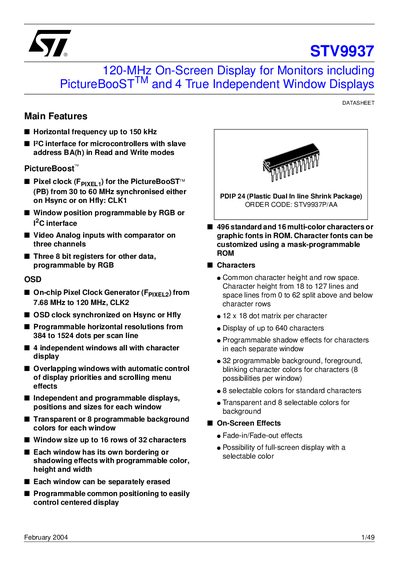
The STV9937 is an advanced on-screen display (OSD) generator designed specifically for CRT monitors. It features a patented PictureBooST system that enhances image brightness and sharpness, allowing for TV-like effects directly from the monitor board without additional components.
The device supports up to four independent character windows with programmable positions, sizes, and overlapping capabilities. Key features include an on-chip pixel clock generator ranging from 7.68 MHz to 120 MHz, support for horizontal frequencies up to 150 kHz, and a built-in ROM containing 496 standard characters plus 16 multi-color graphic fonts.
| Horizontal frequency | up to 150 kHz |
|---|---|
| On-chip Pixel Clock Generator range | 7.68 MHz to 120 MHz |
| Character ROM capacity | 496 standard and 16 multi-color characters |
| Maximum simultaneous display | up to 640 characters |
| Independent windows | 4 independent windows |
The device supports a horizontal frequency of up to 150 kHz.
The STV9937 allows for the simultaneous display of up to four menus anywhere on the screen.
No, it uses an internal PLL that generates the programmable pixel clock without using a crystal oscillator.