
This article introduces the LTC6803 multicell battery stack monitor, which can measure and digitize the condition of individual cells, as well as monitor the high voltage potential of the combined cells.
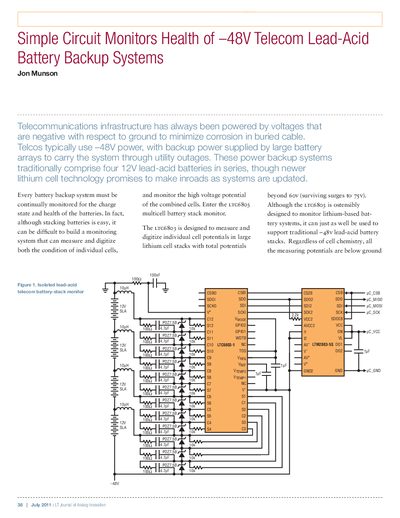
The article discusses how telecommunications infrastructure uses negative voltages relative to ground, typically -48V, backed up by large arrays of lead-acid batteries. While the LTC6803 is designed for lithium-based systems, it can effectively monitor traditional -48V lead-acid stacks.
To measure individual 12V cells within a stack, voltage-divider networks are used to spread the potential across three input channels. The document details how internal discharge switches can be re-purposed with external resistors to create these dividers, achieving an effective full-scale range of 16.1v per battery.
They are measured by summing triplets of input channel readings where voltage dividers split the potential across three channels.
The circuit achieves an effective full-scale range of 16.1v for each 12v battery.
The input channel maxes out at 5.37v, requiring divider networks to measure higher potentials.
Galvanic isolation is desirable to ensure independent measurement regardless of grounding differences.