
The LTC3113 is a single inductor buck-boost converter that offers a compact, highly efficient alternative. Internal low resistance switches allow the converter to support an impressive 3A of load current in a tiny 4mm × 5mm package. The LTC3113 offers an extended input and output operating voltage range from 1.8V to 5.5V, with peak efficiencies reaching 96%.
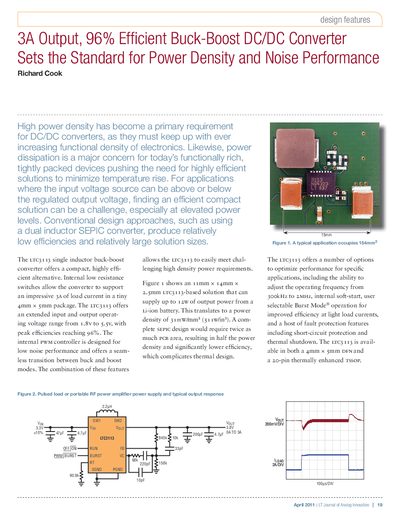
The document introduces the LTC3113 as a single inductor buck-boost converter that addresses challenges with input voltages above or below the regulated output. It highlights features such as 96% peak efficiency, an operating frequency range of 300kHz to 2MHz, and internal low resistance switches for high power density.
| Output Current | 3A |
|---|---|
| Peak Efficiency | 96% |
| Operating Frequency | 300kHz to 2MHz |
| Package Options | 4mm x 5mm DFN and 20-pin TSSOP |
The LTC3113 is a monolithic buck-boost converter that breaks new ground in power density, low noise operation, and high efficiency across a wide range of load currents.
Yes, the high output current capability of the LTC3113 is often sufficient to support transmit current in GSM applications without needing expensive supercapacitors.
It uses a low noise switching architecture to reduce unwanted subharmonic frequencies and minimizes pulse width jitter, which is critical for RF transmission.