
This article introduces a synchronous buck regulator for use in automotive intermediate buses that can provide a 5V gate drive voltage to power MOSFETs even when the input voltage drops below 5V.
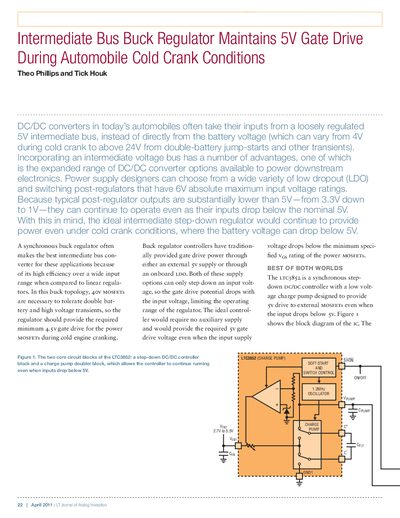
The document details the design features of the LTC3852, an intermediate bus buck regulator designed to maintain a regulated 5V output even when the input voltage drops below 5V. This capability is crucial for driving external MOSFETs in automobile applications during cold engine cranking events where battery voltage can fall as low as 4V.
The LTC3852 integrates an asynchronous buck regulator controller and a charge pump doubler block. The charge pump ensures that the gate drive potential remains at 5V regardless of input fluctuations, allowing the power supply to operate efficiently from inputs as low as 2.7V up to 38V without requiring an auxiliary gate drive supply.
The regulator can be configured to operate from voltages as low as 2.7V.
The device can operate from input voltages as high as 38V.
No, it operates from low voltages with no external gate drive supply required.