
This document describes a simple design for a multiple output range 16-bit DAC. The product is suitable for industrial process control equipment, analytical and scientific instruments, and automatic test equipment. With the new LTC®1592 multiple output range DAC, all standard industrial ranges can be accurately and software-configurably outputted.
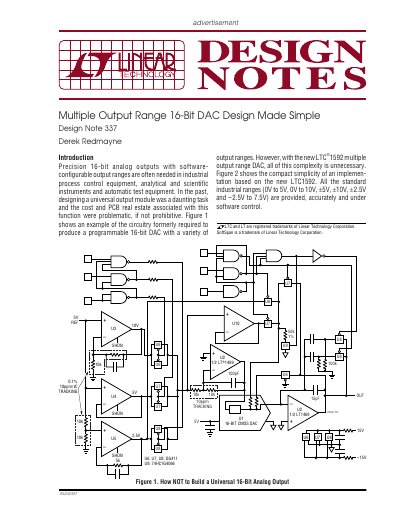
This document describes the design of a 16-bit digital-to-analog converter (DAC) with multiple output ranges, highlighting the complexity of previous implementations and the simplicity of the LTC1592 solution. It includes circuit diagrams and information about standard industrial ranges.
The text contrasts an old method requiring costly components and significant PCB real estate with the new LTC1592 approach, which incorporates all necessary switches and precision resistors under processor control for a compact, accurate, and low-cost design.
The device provides accurate outputs for all standard industrial ranges including 0V to 5V, 0V to 10V, –5V, –10V, –2.5V and –2.5V to 7.5V.
A complete implementation takes less than 0.5in · 0.5in when including the dual operational amplifier, bypass and compensation.
The LTC1592 is a precision 16-bit analog output device.