
This design note describes a positive-to-negative voltage converter (P2N) that can produce a stable output voltage even with a widely varying input. This topology is particularly useful for battery-powered devices, where the battery voltage can vary significantly over time. The P2N can also be used in other applications where a stable output voltage is required, such as in wireless radios.
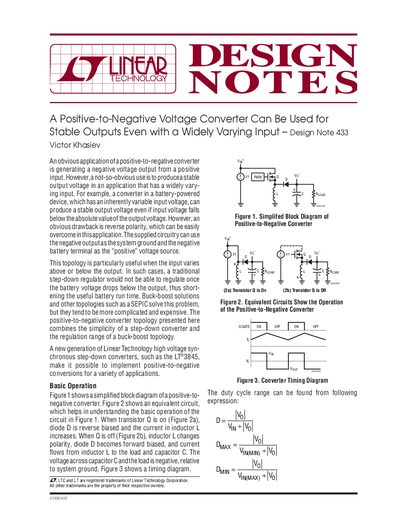
The document presents a design note for creating a stable negative voltage output even when the input voltage varies significantly, such as in battery-powered devices. This topology is highlighted as a simpler and more cost-effective alternative to traditional step-down regulators or complex solutions like SEPIC converters that struggle with reverse polarity issues.
It produces a stable output voltage even if the input voltage falls below the absolute value of the output voltage.
The circuit converts an input ranging from 9V to 15V into a -12V output at 3A.
The maximum voltage (Vax) equals the maximum input voltage plus the output voltage.