
This document discusses the application considerations and circuits for a new chopper-stabilized op amp. By utilizing chopper-stabilization techniques, this op amp is able to achieve excellent DC performance using relatively primitive components.
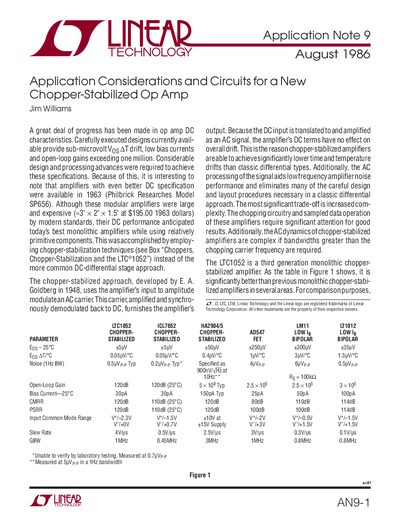
The document provides an overview of chopper-stabilization techniques used in the LTC1052 monolithic amplifier to achieve ultralow time and temperature drift. It compares the LTC1052's performance against other conventional amplifiers like FET input and bipolar types, highlighting its superior DC specifications.
A significant portion of the text addresses practical design issues such as thermal EMFs (Seeback effect) generated by dissimilar metal junctions in connectors and solder. The note offers specific layout strategies to minimize these errors, including using Teflon standoffs for high-impedance inputs and guarding techniques on PCB traces.
They achieve significantly lower time and temperature drifts than classic differential types because DC input terms are translated to AC signals for processing.
Connectors may be avoided or replaced with Teflon standoffs so the inputs never contact the PC board; alternatively, a guard trace driven at the input potential can encircle the input.